Production Case StudyAI Chatbot & Business Automation

AI Customer Support Chatbot with RAG & Vector SearchChatbot for Business & RAG Knowledge Base Automation

Built an intelligent customer support chatbot and business automation triage system using n8n and Supabase pgvector RAG. Automatically answers customer support tickets with zero hallucinations by retrieving precise company documentation.

The Problem & Bottleneck

E-commerce & SaaS support teams face mounting ticket backlogs filled with repetitive policy, shipping, and troubleshooting questions, causing burnout and delayed resolution for urgent customer issues.

The Architectural Solution

Designed a Retrieval-Augmented Generation (RAG) customer support chatbot pipeline. Incoming tickets pass through an AI intent classifier; valid support tickets execute semantic search over a Supabase pgvector knowledge base containing company PDFs and FAQs to draft exact, context-rich answers 24/7.

Measurable Business Results & Impact

Auto-resolved 70% of routine customer support tickets without human intervention
Eliminated AI hallucinations by anchoring responses directly to vector document chunks
Instant PDF knowledge base syncing allows immediate policy updates without model retraining

Detailed Case Breakdown

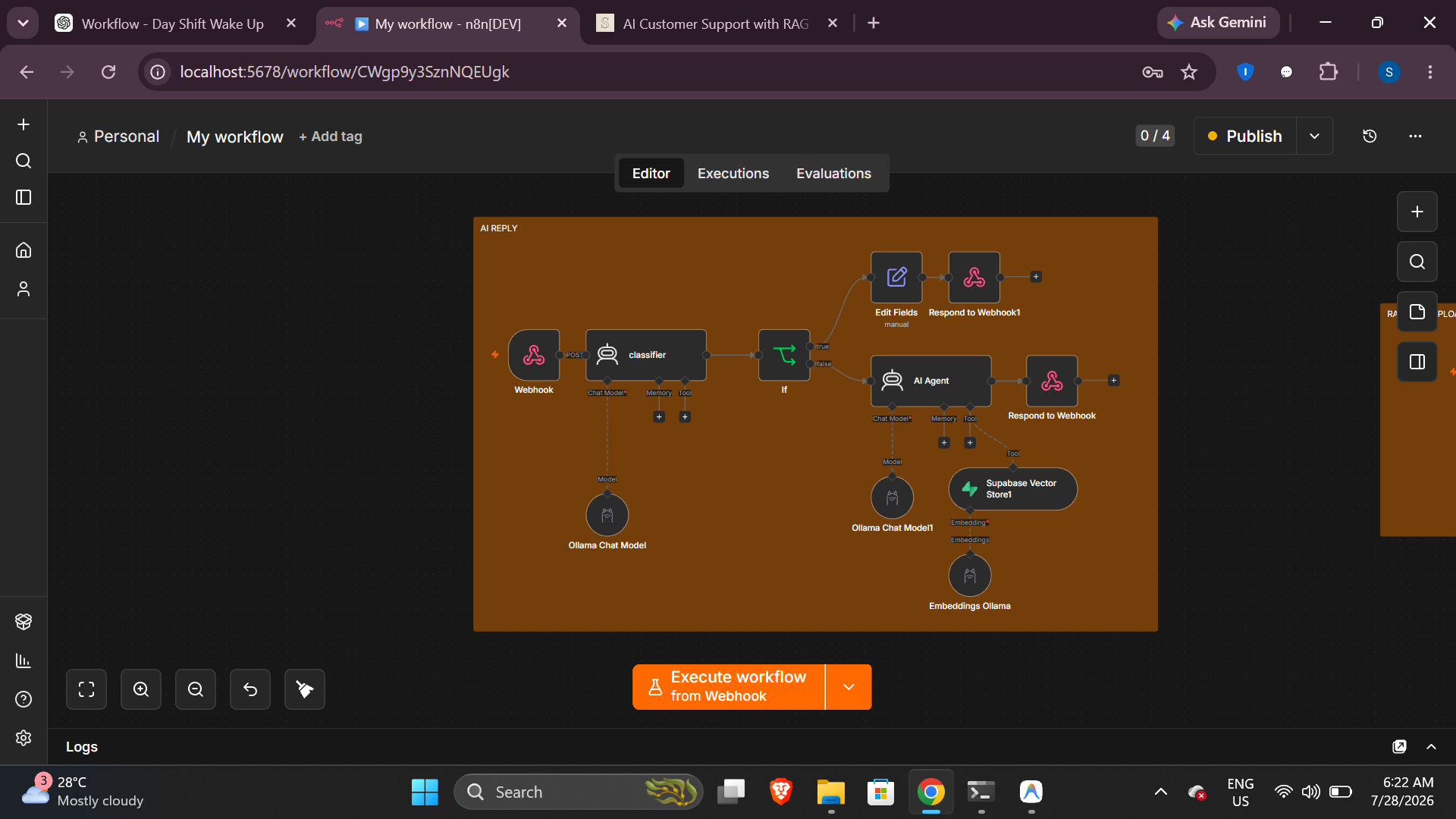
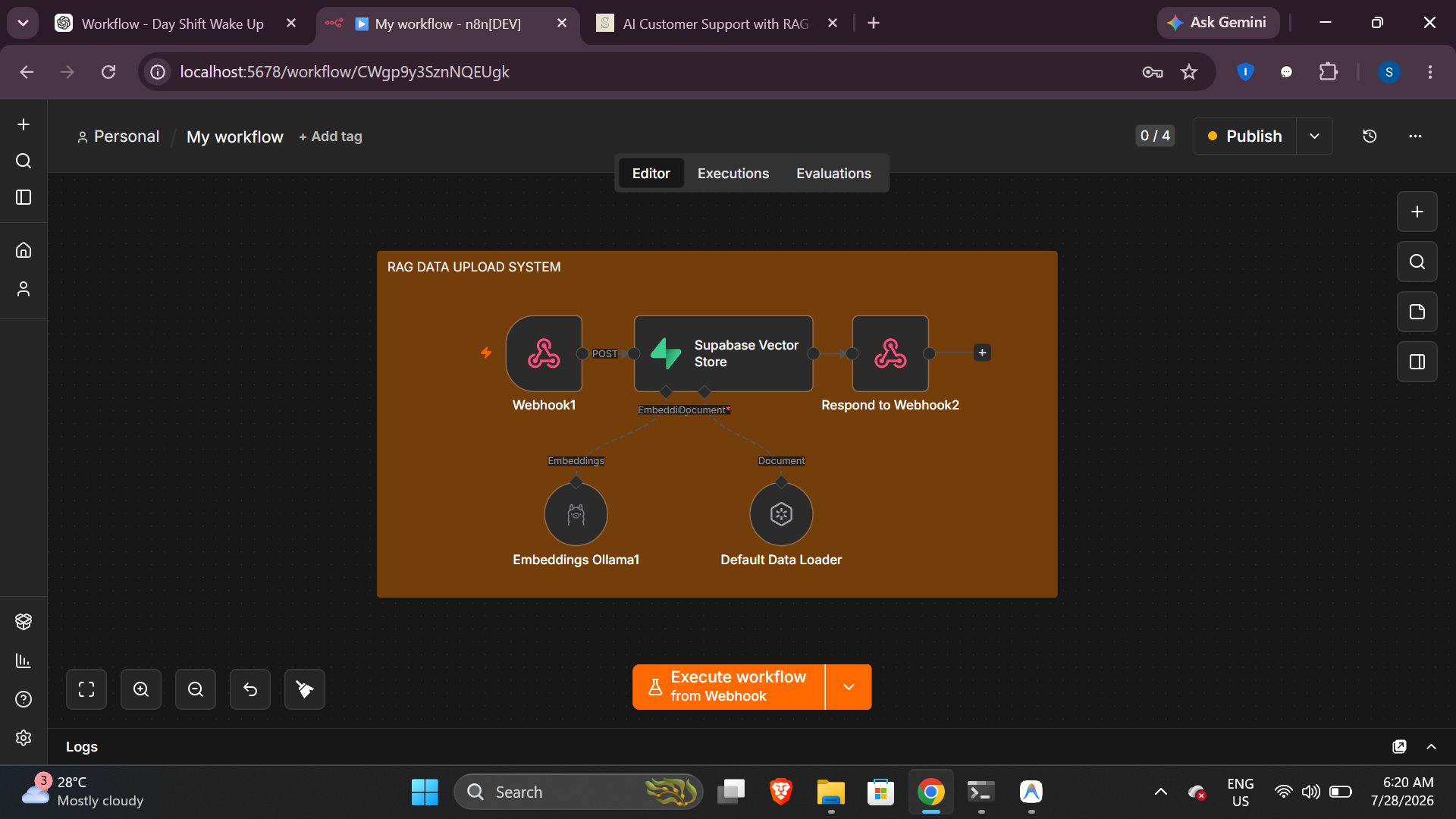
This project automates the complete customer support process using n8n, Ollama, Supabase Vector Database, and Retrieval-Augmented Generation (RAG). When a customer submits a question through the website, chatbot widget, or application, the workflow is automatically triggered via a webhook. An AI classifier first determines whether the message is related to customer support or is an unrelated request. If the query is not support-related, the system immediately returns a predefined response. If it is a valid support request, the message is forwarded to an AI Chatbot Agent for intelligent processing. The AI Chatbot Agent is connected to a semantic search tool powered by a Supabase Vector Database. Instead of relying solely on the language model's internal knowledge, the chatbot searches the company's knowledge base for the most relevant document chunks before generating a response. PDF documents containing product information, shipping policies, return policies, warranty details, FAQs, and troubleshooting guides are automatically converted into embeddings and stored as vectors. During every customer interaction, the system retrieves only the most relevant information, ensuring that responses remain accurate, context-aware, and consistent with the latest company documentation while eliminating hallucinations. To simplify knowledge management, the project includes a dedicated RAG data upload workflow. Whenever administrators upload a new PDF document, the system automatically extracts the text, splits it into meaningful chunks, generates vector embeddings using Ollama, and stores them in the Supabase Vector Database. This allows the AI chatbot assistant to instantly access newly added information without requiring model retraining, providing scalable 24/7 business automation.
Key Features & System Capabilities

AI-powered customer support chatbot for business
Intelligent query classification and intent detection
Retrieval-Augmented Generation (RAG) with zero hallucinations
Semantic vector search using pgvector and Supabase
Automated PDF knowledge base indexing and chunking
AI Chatbot Agent with tool calling and context memory
Automatic embedding generation using Ollama
Scalable knowledge base management without retraining
Easy integration with websites and WhatsApp through Webhook APIs
Accurate responses based on company documentation instead of general AI knowledge
Technologies & Integrations:AI Chatbot DevelopmentChatbot for Businessn8n AutomationRAG Vector SearchSupabasepgvectorAI Automation ServicesWebhook API
Swipe ?1 of 3
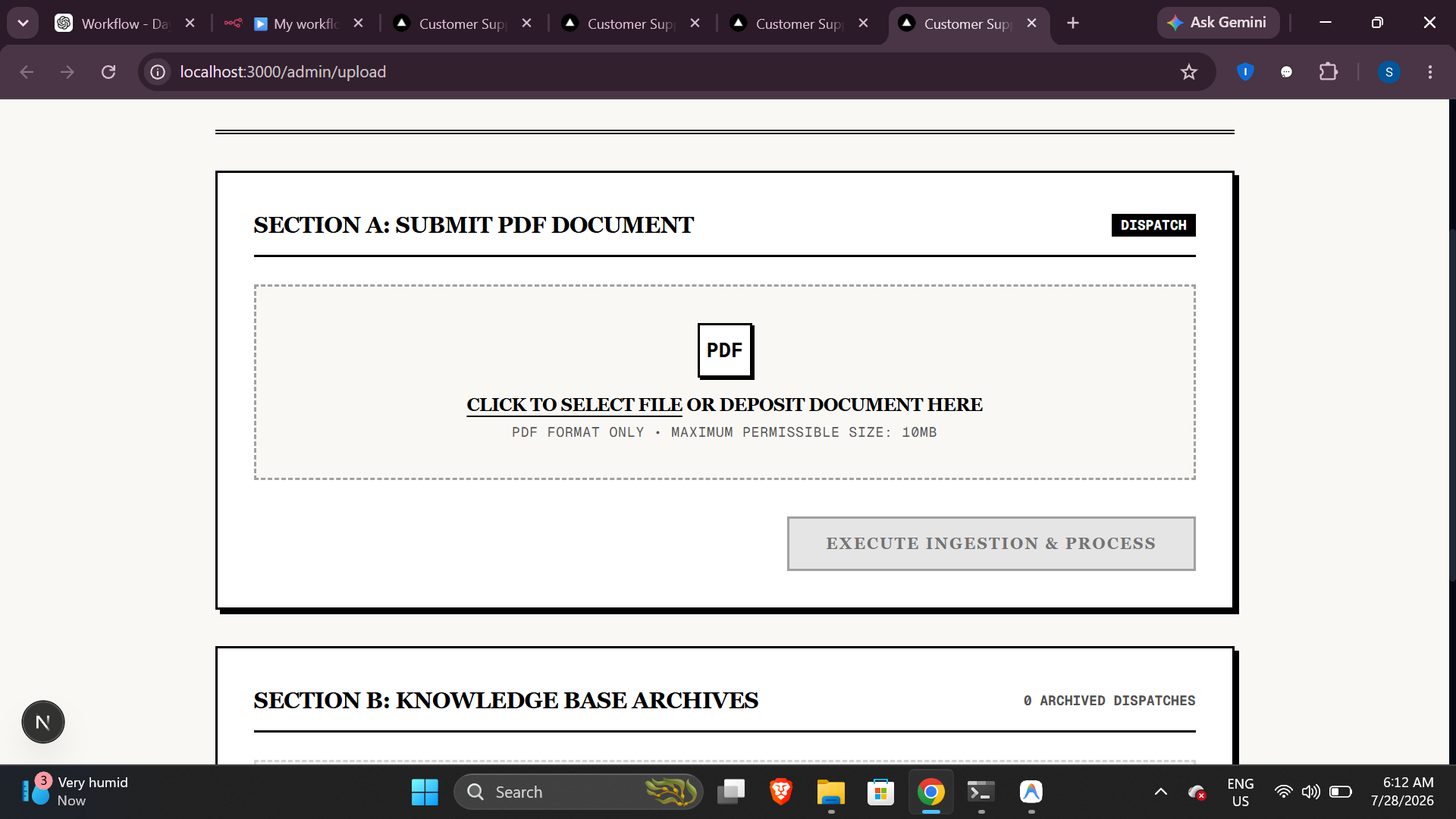
Step 1: Knowledge Base Upload — The administrator uploads company PDF documents through the admin dashboard. Once uploaded, the document is processed automatically, allowing the AI assistant to answer customer queries using the latest company information.

Step 1: Knowledge Base Upload — The administrator uploads company PDF documents through the admin dashboard. Once uploaded, the document is processed automatically, allowing the AI assistant to answer customer queries using the latest company information.

Step 2: Document Processing & Vector Storage — After a document is uploaded, the system automatically processes its text, splits it into structured chunks, and stores it in the database. This enables fast and accurate search when the AI responds to customer queries.

Step 2: Document Processing & Vector Storage — After a document is uploaded, the system automatically processes its text, splits it into structured chunks, and stores it in the database. This enables fast and accurate search when the AI responds to customer queries.

Step 3: AI Query Processing & Response Generation — When a customer query comes in through the webhook, an AI classifier automatically analyzes and categorizes it as either a booking request or a general inquiry, then routes it to the appropriate branch using a switch node. Booking requests are handled by a dedicated AI agent that updates the customer's details in a connected Google Sheet and instantly sends back a confirmation via webhook, while general inquiries are handled by a separate AI agent that retrieves relevant information from a Supabase Vector Store using Ollama embeddings and generates an accurate, context-aware response before sending it back to the customer. Both branches are powered by their own Ollama Chat Models, allowing the system to deliver real-time, personalized, and reliable responses completely automatically, without any manual intervention.

Step 3: AI Query Processing & Response Generation — When a customer query comes in through the webhook, an AI classifier automatically analyzes and categorizes it as either a booking request or a general inquiry, then routes it to the appropriate branch using a switch node. Booking requests are handled by a dedicated AI agent that updates the customer's details in a connected Google Sheet and instantly sends back a confirmation via webhook, while general inquiries are handled by a separate AI agent that retrieves relevant information from a Supabase Vector Store using Ollama embeddings and generates an accurate, context-aware response before sending it back to the customer. Both branches are powered by their own Ollama Chat Models, allowing the system to deliver real-time, personalized, and reliable responses completely automatically, without any manual intervention.

Tailored Automation Solution

Want a Similar System for Your Business?

Book a call to discuss building a custom AI & n8n workflow system designed specifically for your operational goals.

Book a Call for this Project